
Once Upon a Time There Was a Sailor
Once upon a time there was a sailor; and the sailor sailed across the ocean for many days and many weeks until eventually he came upon an island. The island was very lovely. The sailor went ashore and he gazed up at the green trees, which were so refreshing to his eyes after such a long time spent staring only at the vast blue desert. He heard the breeze passing through the leaves of the trees and he smelled the blossoms. Here and there he saw ripening fruits.
The sailor had not tasted fresh fruit or green vegetables since he was about seven days out from his last port of call. For the past few weeks he had lived on dried beans, rice, and tinned tomatoes. He saw that on this beautiful island a man might grow his own lettuces and sweetcorn; onions, yams, carrots, and peppers; mangoes, papayas, melons, pineapples, and grapefruits. It seemed to him that, with a patch of ground and a hoe, in this place a man might live like a king. And so the sailor decided to stay. He bought a piece of land, he sowed some seeds, and he became a gardener.
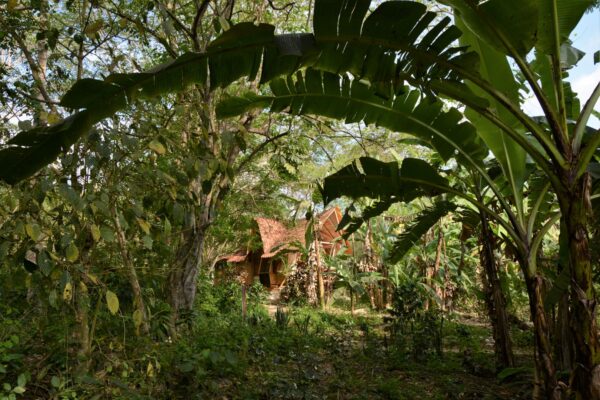
Rain fell and the sun shone down. The seeds awoke and sent tiny leaves up from the soil, and the gardener nurtured them. When the clouds passed the island by, forgetting to rain, he carried water from the well to his garden and carefully refreshed each thirsty seedling. When weeds grew alongside those precious ones, he ruthlessly tore out the interlopers. Every morning he inspected the little, tender leaves of his plants and tore off any caterpillars and beetles which had dared to try to set up camp there. He chased away the pigeons. He built a fence to keep out the wild pigs.
The little plants grew. The papaya tree reached for the sky and then, under its frilly thatch of leaves, produced clusters of little white and yellow flowers. The banana palms sprouted huge, waxy green leaves and then dangled purple and red cones on the end of strange umbilical cords. The melon plants went coiling across the ground and put forth yellow trumpets. The beans and the tomatoes struggled to remain upright – and the gardener helped them, pushing canes into the ground and then gently tying the tender branches to them.
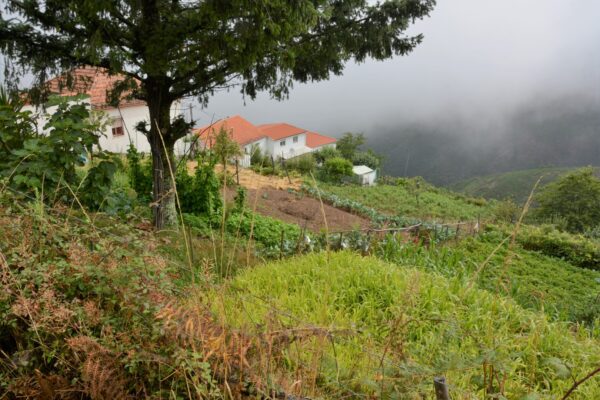
Everything in the garden was wonderful. Everything was thriving thanks to the gardener’s care. The fruits were ripening; the vegetables were almost ready to pick. And then, one day, the wind carried the smell of the salt sea across the land. And the gardener smelled it; and he remembered. He remembered the lift of the waves and the hum of the rigging and the sloosh of the foam dancing past the lively hull. He felt a huge yearning within his whole body. And the sailor went back to the sea.
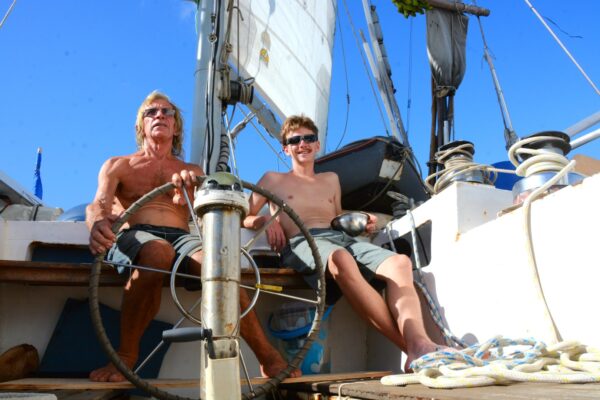
I’d been cruising for just a few months when I first heard this story. It was told to me by another yotty. I guess he must have asked about our plans, and I probably recited a list of places that I planned to visit (as newbies are wont to do), and then I must have mentioned my intention to one day settle down and live ‘off the land’. He laughed. “Once a sailor, always a sailor!” he said. “You won’t be able to give it up.”
Well, it’s now been more than five years since this family of sailors anchored ourselves on a mountainside more than fifty miles from the ocean. Our project was scarcely more carefully planned than that of the gardening sailor in the fable, but our intention was slightly different. In fact, we were considerably more ambitious than he. Whereas that fellow only planned to grow his own food, we also hoped to save the world.
THE BACKSTORY (for anyone who hasn’t been with us throughout this journey) :
Nick and I have always cruised in an environmentally conscious way, aiming to leave only bubbles in our wake. We also raised our children to live life carefully. However, as time went by it became clear that opting out of consumerism and avoiding the use of fossil fuels and plastic packaging is not enough.
Unless you’ve been living under a stone for the past twenty or thirty years, you’ll know that the planet is getting hotter. In fact, even if you’ve been living under a stone you’d know about it, because the ground around your stone will now be drier; or maybe it will have been washed away in a flood. Or both, one after the other.
Even if your stone were in Antarctica you’d know about global warming by now. In fact, Antarctica and the Arctic are both experiencing dramatic and wholly unprecedented increases in temperature. Europe, too, is heating up and is becoming stormier. And North America has also been experiencing radical weather phenomena. It’s pretty clear that this planet is not just plodding along in the same way that it was when I arrived on the scene more than half a century ago. It’s pretty clear that something has gone wrong.
It was back in 1988 that James Hansen made his famous ‘Climate Change’ report to the US senate and broke the news of Global Warming to the world. Having, at that time, no interest in politics or economics or world news, I first heard about the problem a few weeks later through Greenpeace. Up until now, I’d supported this environmental organisation as they fought to protect whales and took action against pollution; but what they were telling me now was on a completely different level. If what Greenpeace said was true, humanity’s use of coal and oil was invisibly but inevitably driving the entire planet towards catastrophic levels of warming. Only Britain and Scandinavia might escape, they informed their followers, because increased heating would eventually cause the Gulf Stream to stop, and this would mean that the British Isles and other Atlantic land masses at that latitude would probably be surrounded by ice…

Clearly, we must all immediately stop burning fossil fuels. And clearly, as it seemed to me, the world’s governments would soon leap into action and ban their use. As I say, I was, at this time, extremely naïve, having absolutely no understanding of politics or economics or of the fact that these two intertwined things directly affect the existence and well-being of every living-being on the planet.
It was just a few months after Greenpeace sent their dramatic news to their supporters that I met Nick; and it was just a few weeks after we met that we set off to live life on our own terms, on the ocean.
You can read all about that little outing here.
At that time, before the invention of the World Wide Web, dropping out meant losing all connection with what was happening in the rest of the world – and so it really was as if we were living under a stone. The fall of the Berlin Wall and the emancipation of Eastern Europe passed us by unnoticed, as did the birth of my niece, and so too the fact that, in the event, the world’s governments didn’t leap into action. Incredibly, James Hansen’s revelation of the existential threat to all life on this planet made no impact whatsoever on global politics.
But, as drop-outs from the system, we didn’t know that. And so, for thirty years, we just pootled merrily along in our own little cosy dream-world, doing our best to leave only bubbles in our wake and footprints on the beach.
If the other seven billion people on the planet had also dropped out, that might have done the trick. If, after the news broke, everyone in the wealthy, developed world had decided to get rid of the car, stop buying stuff, and grow their own food, that might have brought mankind’s carbon gas emissions to something approaching Net Zero. Reduced consumption would also have drastically reduced the amount of plastic being dumped in the ground and in the sea, and it would have reduced the levels of deforestation and of mineral extraction, thereby, in turn, reducing the amount of environmental destruction and habitat loss.
But it didn’t happen.
Alas, most people didn’t change the way they were living.
To be honest, it’s more or less impossible for most of the inhabitants of this planet to entirely escape from The System. We’re all trapped within the net; we’re all reliant on it for our food and clothing and for so many other things that we take totally for granted. Modern civilisation is a ‘food chain’ – it’s a complex, sophisticated web of life – and its tentacles reach out inexorably across the globe and curl themselves around almost every being. (Yes, me included. I hear you!)
But, then again, to be totally honest, so far as I can see most people don’t even want to get out of the net of civilisation. Indeed, most people seem to see it not so much as a snare but as a safety net. For most Westerners, life without the luxury afforded by the modern industrial system is unthinkable. Impossible. And so most of the people who can afford to continue to drive around in cars which pump out CO2, and they continue to buy nice stuff on a whim. (Hey! Remember when our parents used to have to save up for weeks to buy a much-needed pair of shoes for our bigger-than-last-year feet?)
You’ve probably already seen this brilliant little video about the life-cycle of the stuff that we buy. I don’t claim to be a saint in this respect, but when I feel the urge to acquire more possessions, I think of this cartoon; and if I can’t make-do or mend, I try to find a second-hand solution to my needs or desires. Second-hand stuff saves the planet.
Having said all of this – and having made both you and myself feel guilty and defensive – in the final analysis only government policy can change the way the world works. The only thing that could change humanity’s chaotic, high-speed descent into the inferno of Climate Change would be laws and tax breaks. For a long while I pinned my hopes here. Surely, if the problem were really real, the men who run our countries would do something about it – wouldn’t they?
Wouldn’t they…?
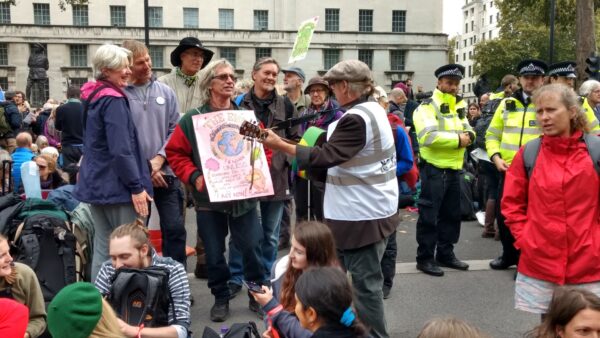
As the years roll by it has become increasingly clear that the world’s governments – whether democratic or despotic, left-leaning or right – are all in thrall to a thing called Economic Growth. The fact that infinite economic growth is impossible on a finite planet has had no effect at all on our governments’ plans and calculations. The fact that economic growth necessarily entails plundering the Earth of her minerals and abusing all other life forms has had no effect on the rationale of the men who run and ruin our world.
This failure on the part of our leadership is taking us all to a place as hot as hell. And yet the people still continue to elect ‘alpha male’ types to run things. And incredibly – stupefyingly – most people are still partying!
We’re all bickering over the popcorn while the cinema burns down around us. We’re like fish stranded in a puddle and circling around, our destiny totally apparent as the sun blazes down and the water dries up.
Do fish in a puddle all hope for a miracle, I wonder? I guess they must do.
Am I cheering you up? Well, I’m sorry, but if we don’t face the music – if we just keep going round and round in the puddle – nothing is going to get better. Rather, it’s going to get worse.
Ten or twelve years ago, like a good many other citizens of this globe, I became increasingly depressed about the future – or, more specifically, about my children’s future. Ten years ago, the headlines were screaming, “Only 12 years left to save ourselves from Hell on Earth!” It felt as if all humanity and everything else in this wonderful world was on a high-speed train which was hurtling towards a wall. So, as I say, I finally saw that opting out wasn’t enough. I decided that we’d better do something to help to put the brakes on. That something was a Garden Plus.
Thus it was that, at the time when the world went into lock-down mode and cruising became all but impossible, three sailors who had spent the past three decades drifting on the ocean’s currents came ashore, climbed a mountain, and sowed some seeds.
First we tackled a patch of land which for the previous twenty or thirty years had grown only weeds, and we planted a vegetable garden. Then we started work on our Forest Garden. The idea here is to plant a carefully managed open woodland consisting of fruit and nut-bearing trees together with equally useful bushes and, beneath them, useful ground-cover plants. The place appointed for the Forest Garden project consists of an erstwhile impossibly steep mountainside which has been terraced (who knows how many centuries ago?) but whose land is still inclined at up to 30 degrees.
As if that were not enough of a challenge for three individuals who had previously never held a spade or a hoe or nurtured anything green other than mung-beans in a jar, we also bought the naked hillside opposite the terraces with the intention of planting a forest of native trees.
Easy, huh? “Let’s just get out there and rewild the world!”
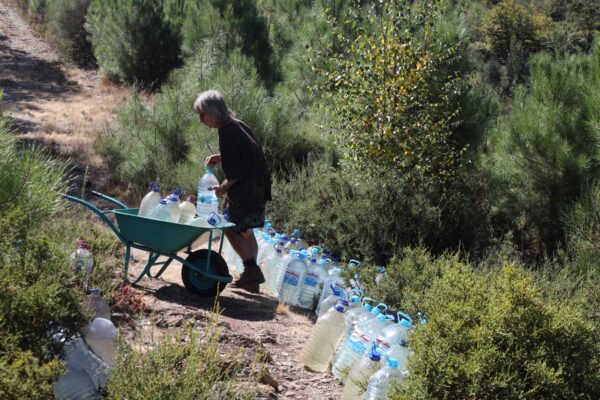
Hmmmm…. Well, growing veg turns out to be a lot easier than I’d imagined – provided, that is, that you take the time to weed your garden, and provided you give your plants plenty of goat manure and adequate water.
Growing trees, on the other hand, is a lot harder than I’d hoped. They also need food and water, and they need protection from all sorts of enemies such as wild boar, deer, caterpillars, and fungi. If left to their own devices young trees are quickly overcome by brambles and other more resilient plants better adapted to the harsh conditions. Our soil is thin and arid and ‘poor’ (which is to say that it lacks nutrients). Brambles don’t care, but pears, plums, and peaches do.
There’s a reason why our land was very cheap. There’s a reason why young people in this country where we’ve washed-up don’t want to spend their lives as their ancestors did, growing corn, potatoes, and beans on a mountainside. The young people know that their grandparents had to strive every day to provide enough food for hungry mouths.
There’s a reason why the people of my generation moved to the city. And because they grew up in a city, the people of my children’s generation hardly know a moth from a butterfly or a snake from a slow worm – or, more to the point, a potato plant from a dandelion. And they don’t want to know!
To be frank, the young people of this country find our enthusiasm for their grandparents’ land totally bewildering.
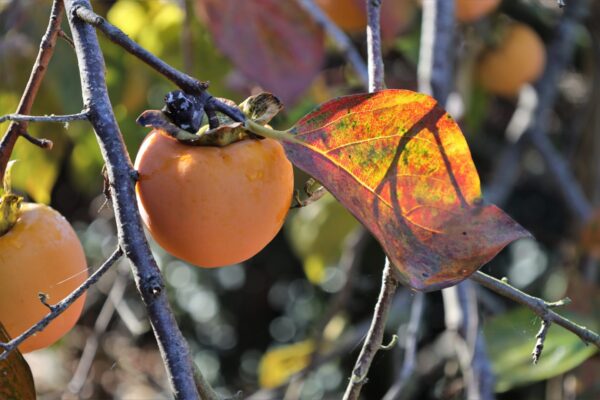
And after five years of tending this land and trying to conjure up a forest, how do the sailors feel about things? Have we metamorphosed into gardeners? Is the old fable a myth?
Yes and no. After one year on our land, I was in love with this place. After two, even more so. But – simultaneously – after two years of hard work for no reward, a part of me was yearning to move on…
We spent three decades of our life always moving on.
We spent three decades falling in love with valleys and villages and then sailing away, saying to ourselves, “We’ll come back here one day.”
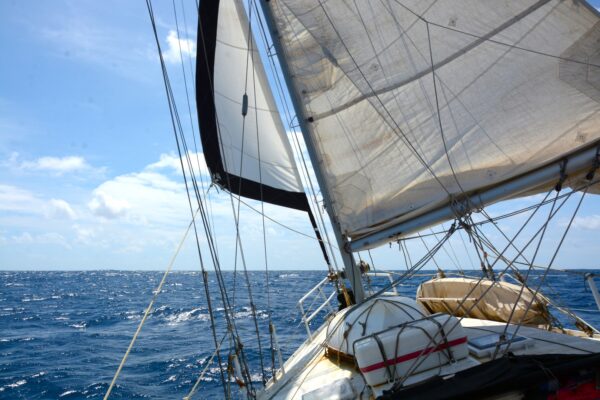
There are a lot of places that we’ve visited that I think of fondly. I’ve always been keeping an eye open for The Perfect Place. I’ve never found it. But there are lots of places where we could have thrown out the anchor for good if the time had happened to be ripe. Life is a journey, and the journey is full of crossroads. We could have turned off sooner. Or we could have pressed on until… Until what?
Our meanderings brought us to this beautiful place, and we don’t have any regrets. But…
But I’ve learned that I will always be a sailor. And I won’t ever really be a gardener.
When we’re on the boat, we’re in our element. When I’m on the land, I’m just a sailor who gardens. This isn’t a choice; it’s the same thing as nationality. We were all three born and brought up sailing, and messing about in boats is our natural habitat. However much I love this mountainside and our Forest Garden, and however much time and effort I invest in it, I still won’t ever be a native citizen of Gardening.
When I plant another tree and wonder whether I’ve done it right, I think of all the times I’ve watched someone make a mess of anchoring. And when I tie the tree to the post with a reef knot, I smile to myself… There are only two other people in this village who can tie a proper knot or coil and throw a line.
So, that yotty that I met 35 years ago was right but he was also wrong. Once a sailor, always a sailor. Yes. And we sailors certainly do need our sea-time. But – simultaneously – we’re sticking to the project. The world needs trees. And so, while there is still hope for the world, we will be sailors who garden. If anybody out there wants to come and help, do drop us a line!
I followed you when you were sailing in south america admired your pluck and exploring and hiking the mountains.
Then I flew to croatia bought a catamran sailed the med and baltic for three years. Glad to hear your progress and update. Stay concerned.
Terry
Lovely to hear from you and the family again Jill, and hear what you’ve been up to the past few years! Hope life on the dirt is treating you as well as it can for a dyed in the wool sailor!
Heyy, I am so happy to read this and hear from you, and also, how absolutely fitting, stunning and beautifully written this article is! Not only fitting to the world at large, but also to my experience as well. I have bought a house with a garden two years ago, and we have planted as many trees as we can fit, we don’t mow if we can’t help it, and we do what we can -in our tiny, small way, that nevertheless is huge to a creature such as a sand wasp, or a field mouse, or even a fox.
So I wish you plenty of rain, a good harvest and a lot of laughter and companionship. Warm hugs from Germany, from someone who met you riiight before the pandemic =)